How Jammerbugt Kommune cut its servers from 300+ to 140
Jammerbugt Kommune, a Danish municipality with an IT team of eight, used Mugato to map more than 300 virtual machines and how they depend on each other. With that picture the team found servers doing the same job, consolidated to 140 servers without losing any service and now plans every service window from facts.



From more than 300 virtual machines to 140, with every service kept running.
Data center service windows are planned from Mugato every two weeks.
Jammerbugt Kommune renewed with Mugato for five years in December 2024.
More than 300 servers and no clear map
Jammerbugt Kommune is a municipality in North Jutland serving tens of thousands of citizens. Its IT runs schools, health care, social services and administration, so it has to be available and secure every opening hour.
When Ion-Anastasiu Sanporean joined as system architect in January 2021, his team of eight ran that environment with lean resources. Uptime was acceptable, and acceptable wasn't good enough for services citizens rely on.
Service gaps
Uptime didn't meet the standard citizen services need during opening hours.
Server sprawl
More than 300 virtual machines ran across several domains, with unclear dependencies between them.
Duplicate roles
Several servers ran the same roles and features, adding complexity and license costs.
Blind spots
Without a clear view of how systems connected, a proper risk assessment wasn't possible.
One map, then three phases of change
Mugato, the agentless IT discovery and service dependency mapping platform, was already installed at Jammerbugt but wasn't used to its full extent. Ion saw what the map could do and used it to run the change in three phases.
See the whole estate
Mugato's agentless collection mapped all 300+ virtual machines with their configuration, installed software and communication patterns. Nothing is installed on the servers themselves, and new servers appear in the map on their own.
“One of the best features is the automatic scanning. I'm confident that if a new server appears in my environment, Mugato will catch it automatically and show it in the dashboard.”
Ion-Anastasiu Sanporean, System architect, Jammerbugt Kommune
Consolidate and right-size
With the full picture, Ion found servers running identical roles and features, clear candidates to merge. Mugato's figures for CPU, memory and storage showed what each server actually used over time, so right-sizing followed real consumption.
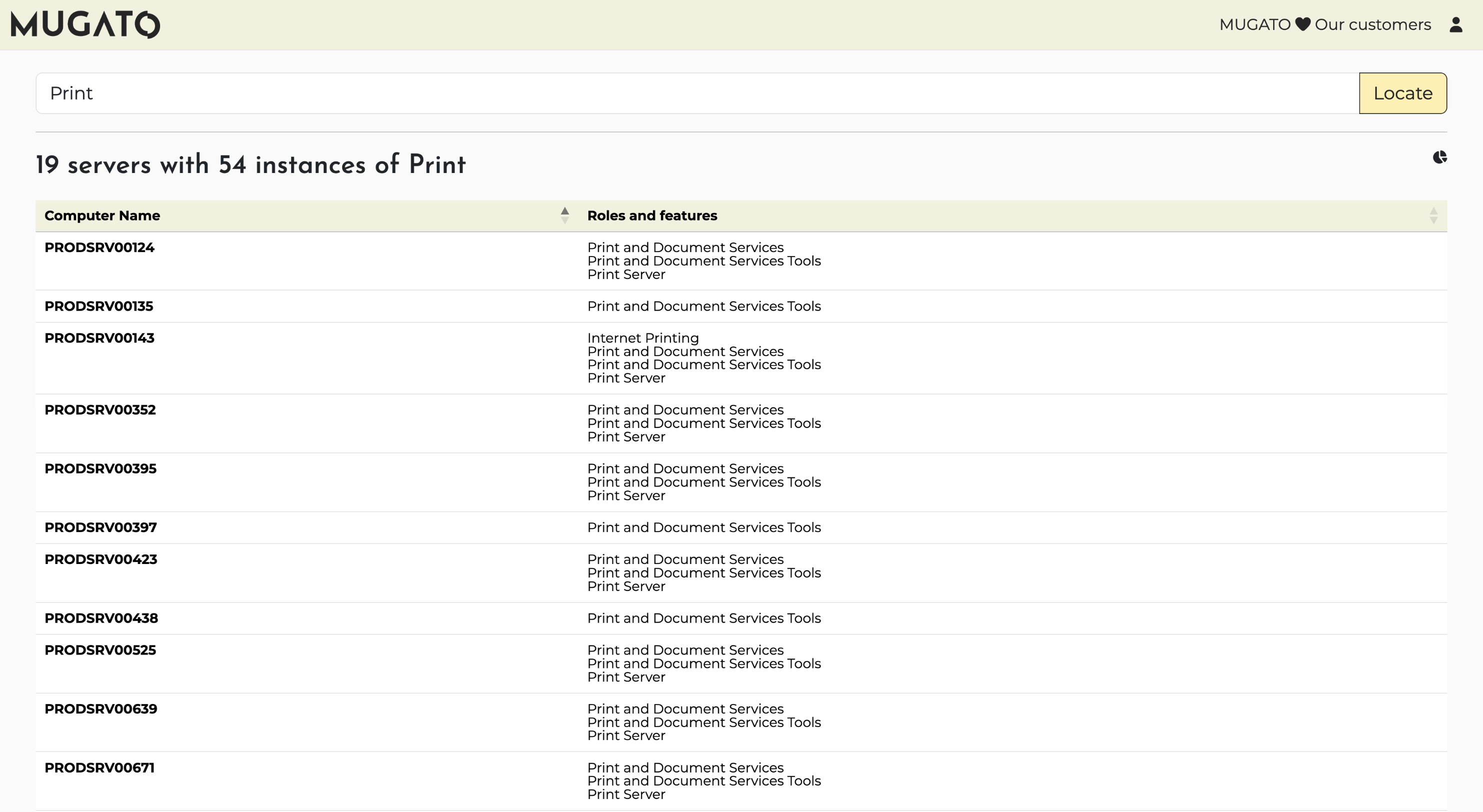
The view Ion used to find servers doing the same job. Shown on Mugato's demo environment.
Check the impact before every change
Knowing exactly which systems depend on which lets the team see the impact of a change before making it. Patch levels across the servers are collected continuously, which keeps security status in view.
“Mugato helps you make decisions. It's not just monitoring, it helps with future infrastructure planning based on real data.”
Ion-Anastasiu Sanporean, System architect, Jammerbugt Kommune
53% fewer servers and a planning routine built on facts
53% fewer servers, every service intact
The estate went from more than 300 servers to 140 while keeping every service running. The team got there by analyzing server roles, removing duplicates and resizing what was left.
Service windows planned from Mugato
Every two weeks the team plans data center service windows with Mugato as the main source. It shows what's critical, what can wait and where resources should move.
“Mugato is one of the major tools we use when planning data center service windows. Based on the risk assessment, we decide what should be handled now, what is critical, what can wait, and then maybe if it's time to give a little bit more resources to a server or take some resources based on the consumption reports.”
Ion-Anastasiu Sanporean, System architect, Jammerbugt Kommune
Custom reports through the API
The team uses the Mugato API for its own reports on SSL certificates, server details and network connections, including the external connections the municipality's services depend on.
A five-year commitment
Jammerbugt Kommune renewed with Mugato for five years in December 2024.

“Mugato gives me both a comprehensive overview and a graduated picture of IT security. I get a basis that enables me to make decisions.”
Morten Hedegaard, CIO, Jammerbugt Kommune
We trust the product. We are using it at least twice per month intensively, and it's one of the major tools we use for planning.
The Mugato capabilities Jammerbugt Kommune used
Cost optimization
Find duplicate and underused servers, then right-size from what they actually use.

Complete discovery
Find every server, and every device a collected server talks to, with nothing installed on endpoints.
Service dependency mapping
Group servers into the application services they run and see what depends on what.













Ready to see the
shape of your IT?
Stay ahead with Mugato: get product updates, event invites,
expert insights and more. Or let us show you how Mugato
can map your entire IT landscape without a single agent.