
Ask your IT in plain language
Connect the AI assistant you already use to Mugato and ask in plain language. Every answer comes from continuously collected meta-information about your environment, with full history since deployment, so you can see what changed, when and what it affected.
Works with the tools your team already uses






Your AI knows infrastructure.
Now it knows yours.
Generative AI assistants reason well about infrastructure in general. They can’t see yours. With Mugato, they can.
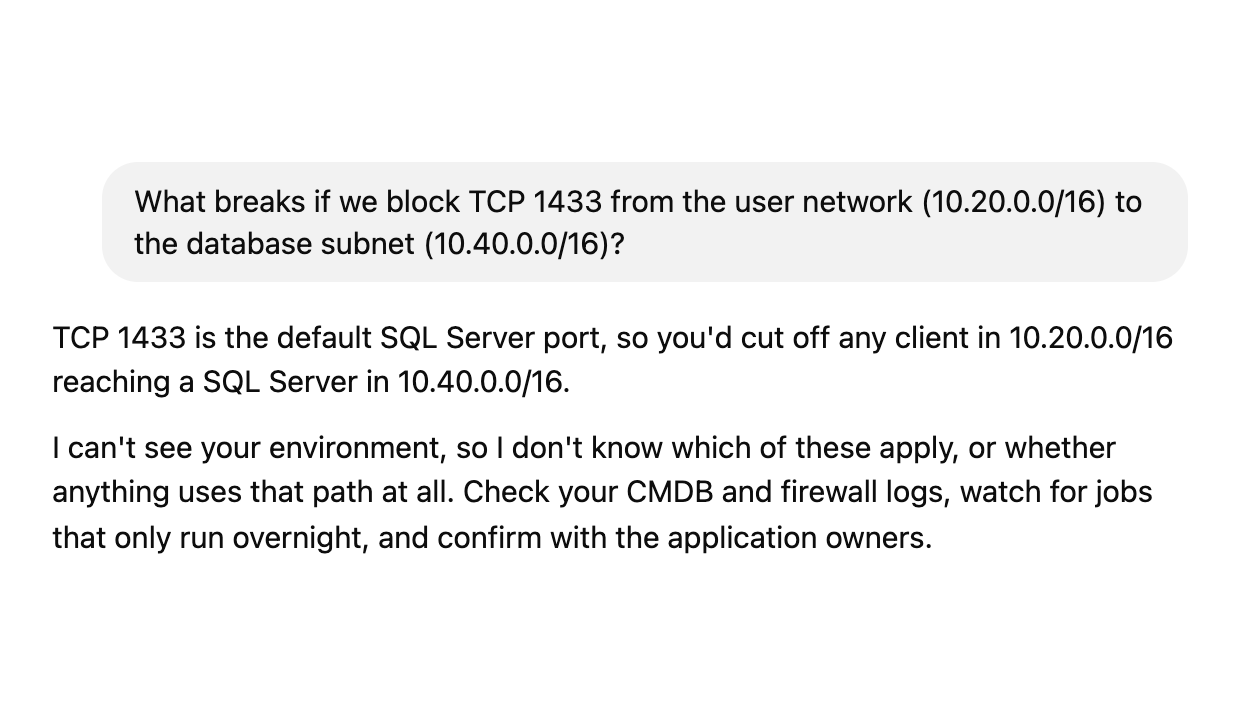
A reasonable guess
General knowledge about how firewall rules and database ports usually work, with a list of things you should go and check.
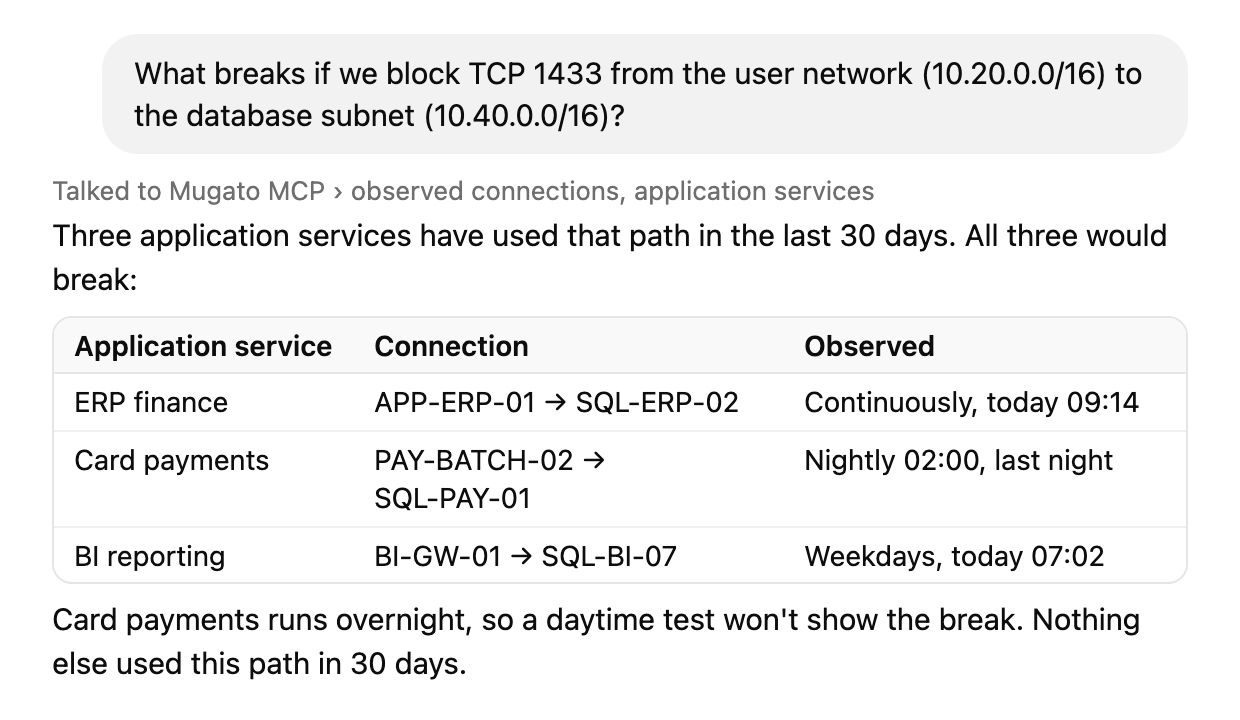
The three services that would break
Named application services, the exact connections behind them and when each one was last observed using that path.
Start where you are
Whatever stage you’re at, the hard part is the same: your AI needs a foundation it can trust. Mugato is that foundation, observed from how your IT actually runs and kept since the day it was deployed, so historical changes, trend patterns and before-and-after comparisons get richer the longer it runs. Start by asking questions. Put the useful ones on a schedule. Hand the proven ones to an agent when you’re ready. The facts underneath never change, and the sooner you start, the more your AI can tell you.
Query
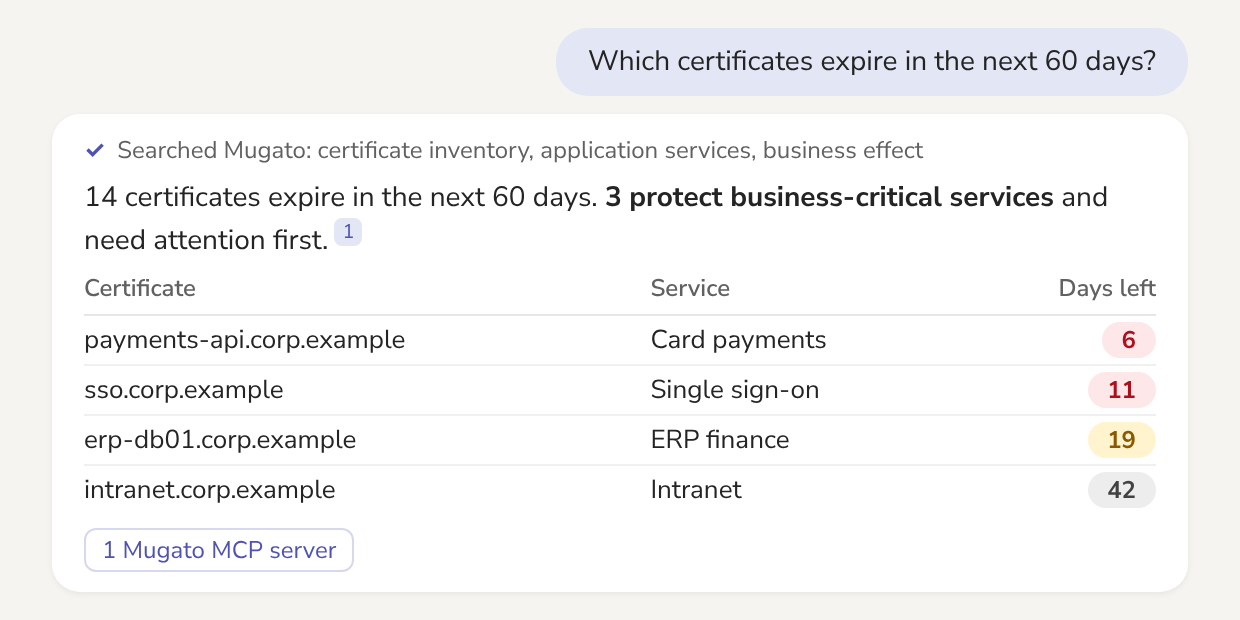
Ask in plain language. Get an answer grounded in your actual environment. A security architect asks which certificates expire in the next 60 days and the answer names the application service behind each one, so the list arrives in the order the work should happen.
Scheduled monitoring
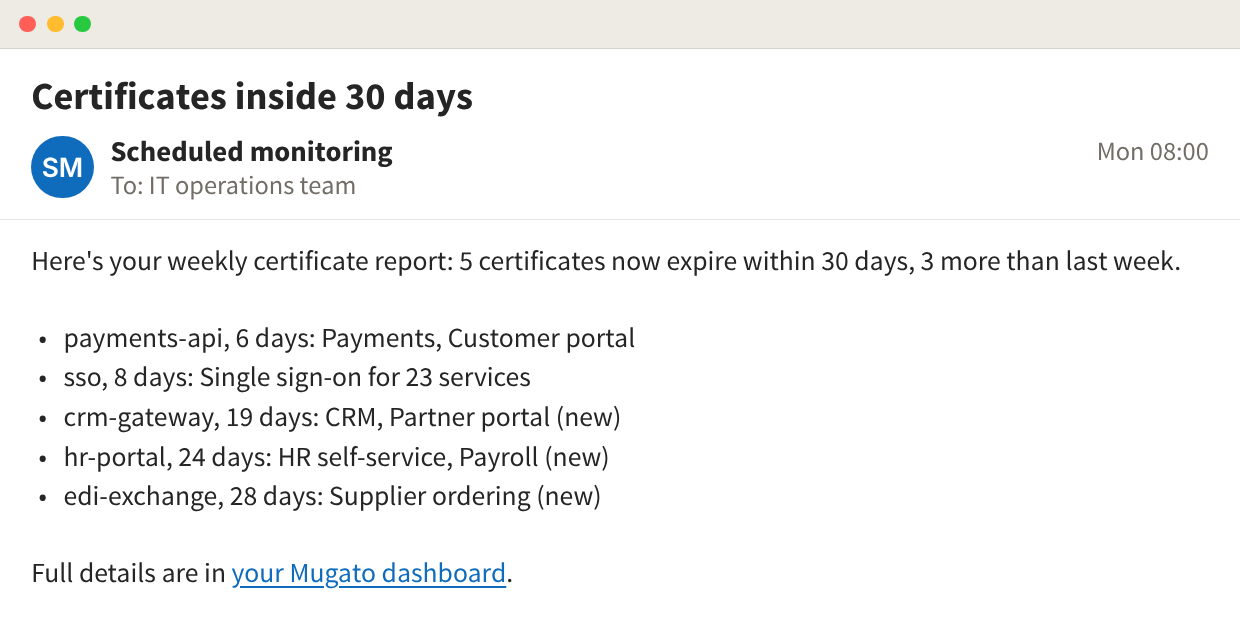
Run a query on a schedule. Get notified when the answer changes: a new risk surfaces, a certificate moves closer to expiry, a security agent stops running. Delivered wherever your team already gets notifications.
Agentic automation
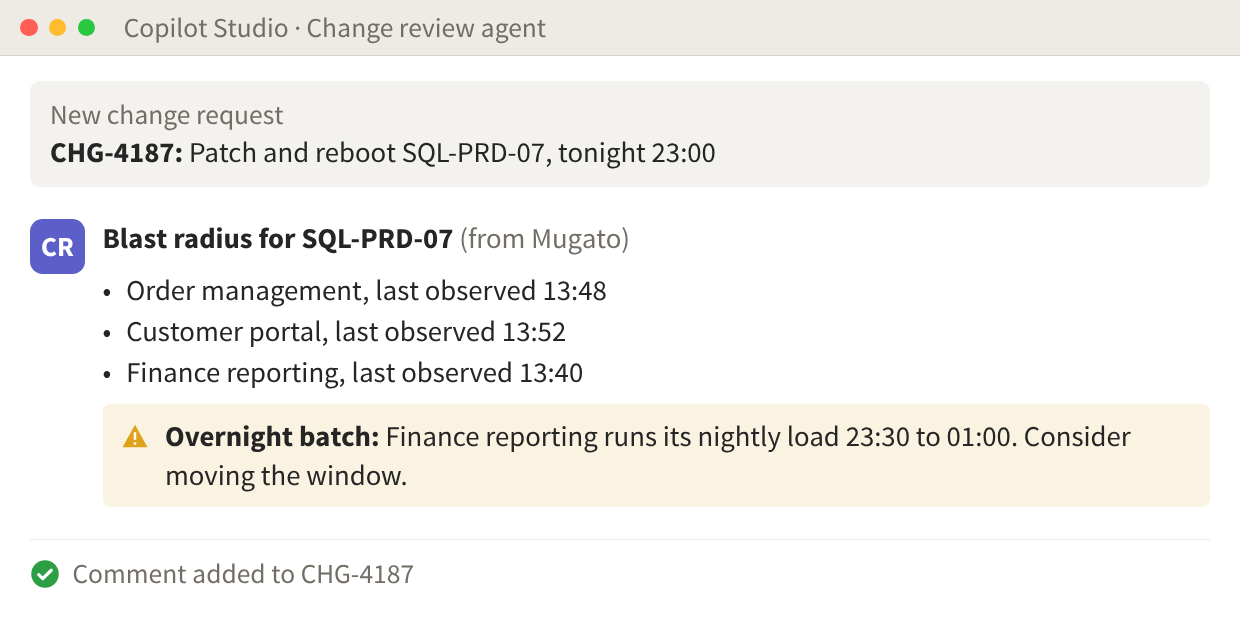
Your own agents in Copilot Studio, n8n or ServiceNow act on Mugato context without a human in the loop for every decision. A change request comes in and the agent attaches the blast radius to the ticket.
Expert answers from a one-line prompt
Most MCP servers simply point your AI at a database. Mugato's is intent-based, so it already knows the job. For every supported use case we loaded in why teams take it on, where it usually goes wrong, which views to open first and what order the answer belongs in. That's decades of enterprise IT experience, all at your fingertips.
Three to four pages of prompt engineering, written by an experienced engineer against the raw schema.
One line, asked in the assistant your team already uses.
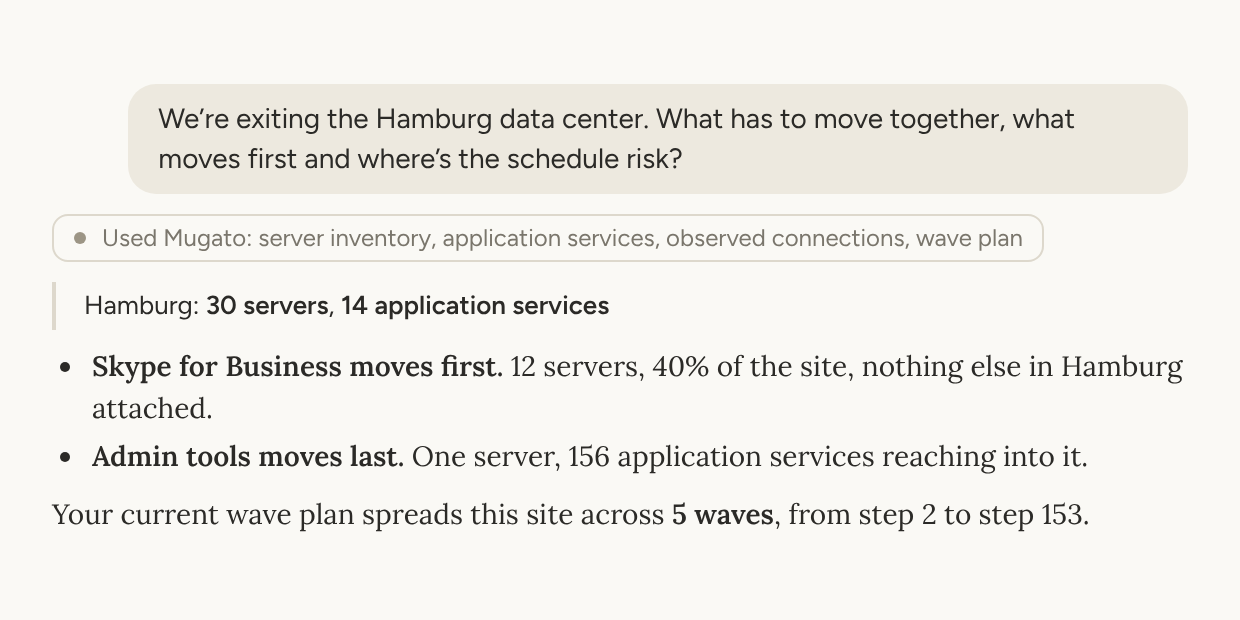
“Make me a prioritized migration plan for application services in a specific data center.”
Dependencies and blockers resolved from observed behavior, not interviews or documentation.
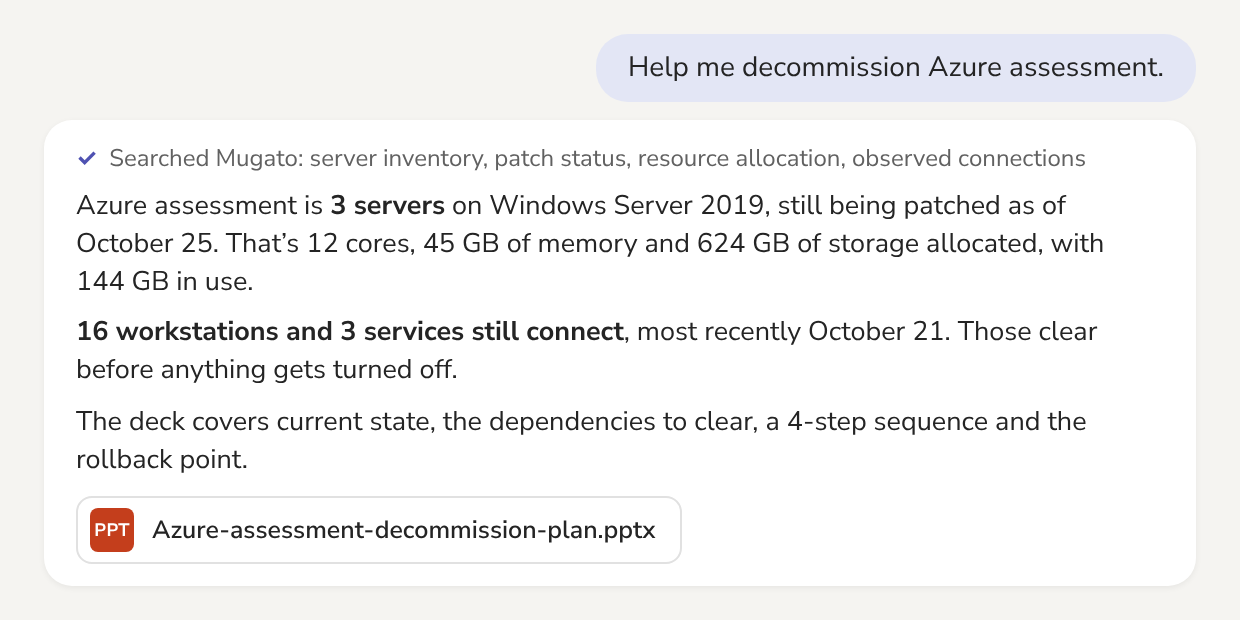
“Help me decommission this application service.”
A step-by-step plan, including PowerPoint output, that surfaces hidden dependencies other services have on what you retire.
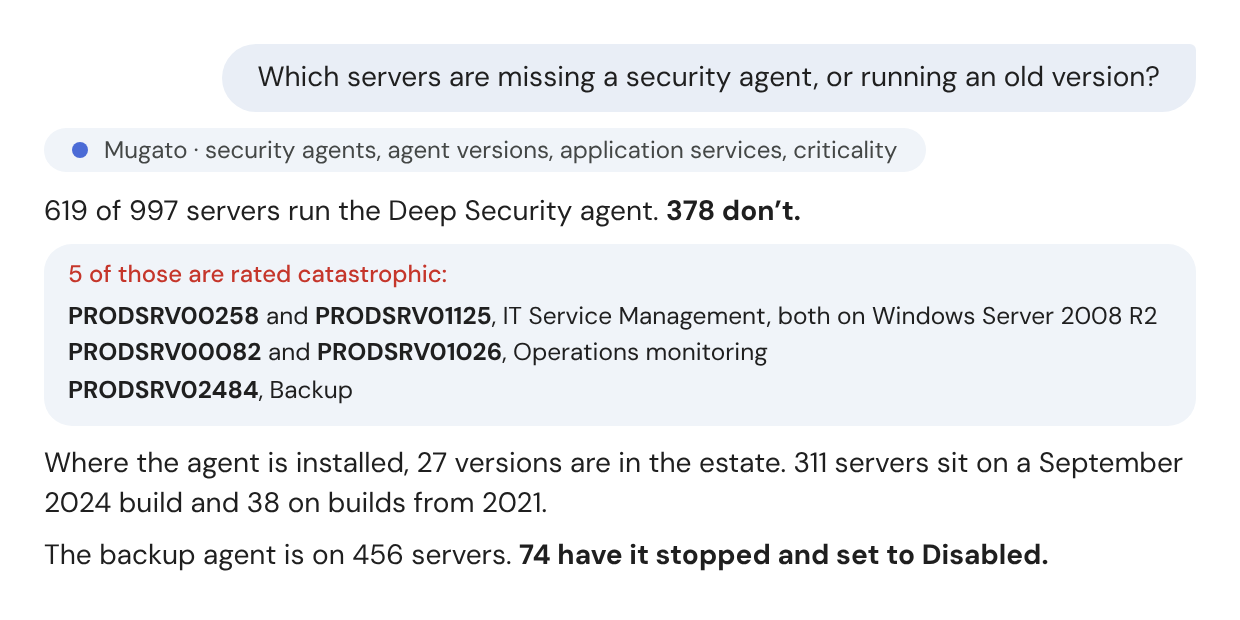
“Are all monitoring and security agents running on all servers, on the right version?”
Immediate visibility without spreadsheets or API scripts.
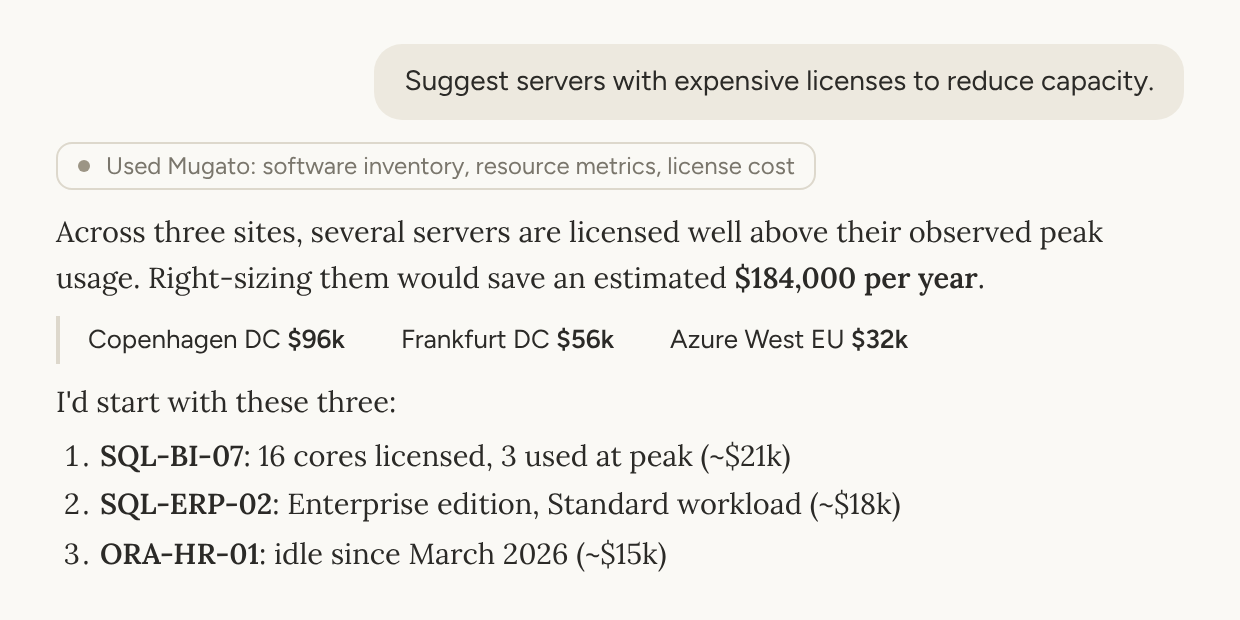
“Suggest servers with expensive licenses to reduce capacity.”
A ranked right-sizing list with aggregate savings estimates and a recommended sequence.
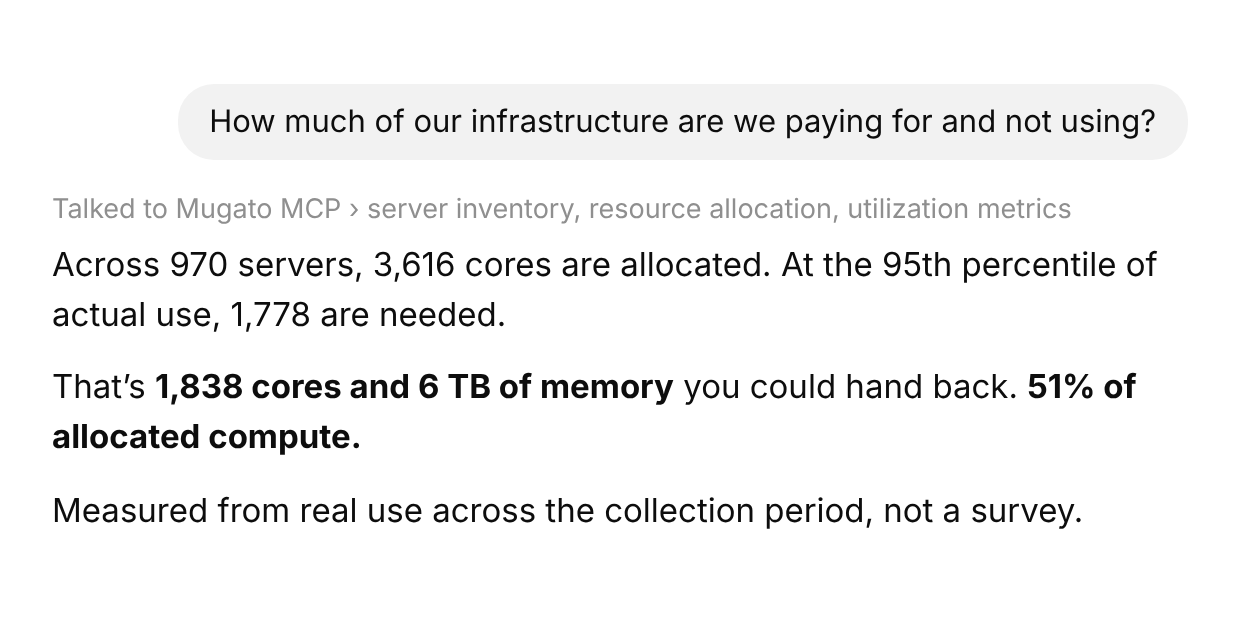
“How much of our infrastructure are we paying for and not using?”
Allocated cores and memory set against the 95th percentile of observed use. The gap is what you can hand back, measured rather than estimated.
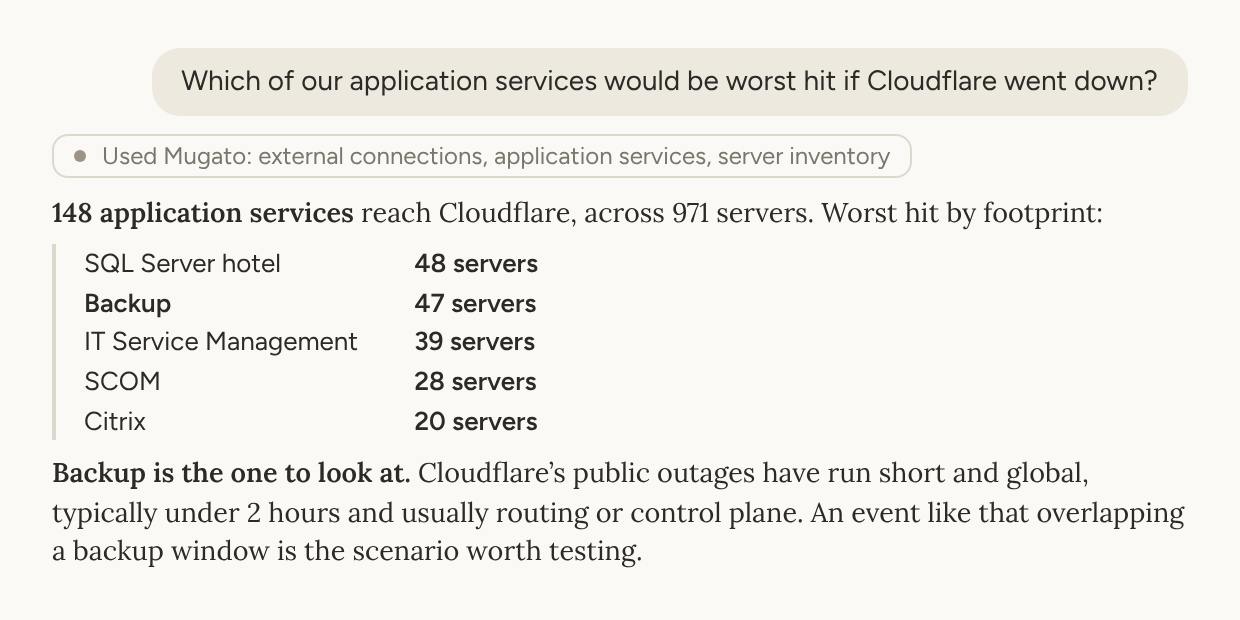
“Which of our application services would be worst hit if Cloudflare went down?”
Mugato’s dependency map combined with your AI’s knowledge of public vendor outage history. No dashboard can answer this on its own.
“Which certificates expire in the next 60 days?”
Ranked by urgency and cross-referenced against business effect. Before the outage, not after.
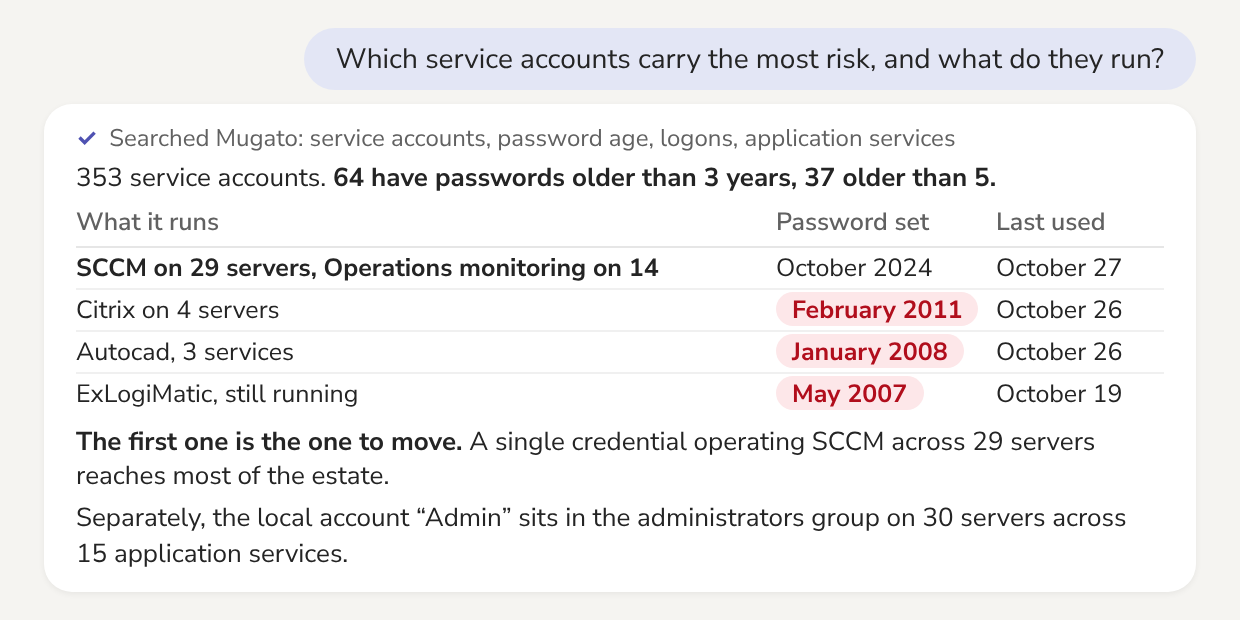
“What are our top 20 riskiest service accounts?”
Ranked by risk and cross-referenced against regulated workloads.
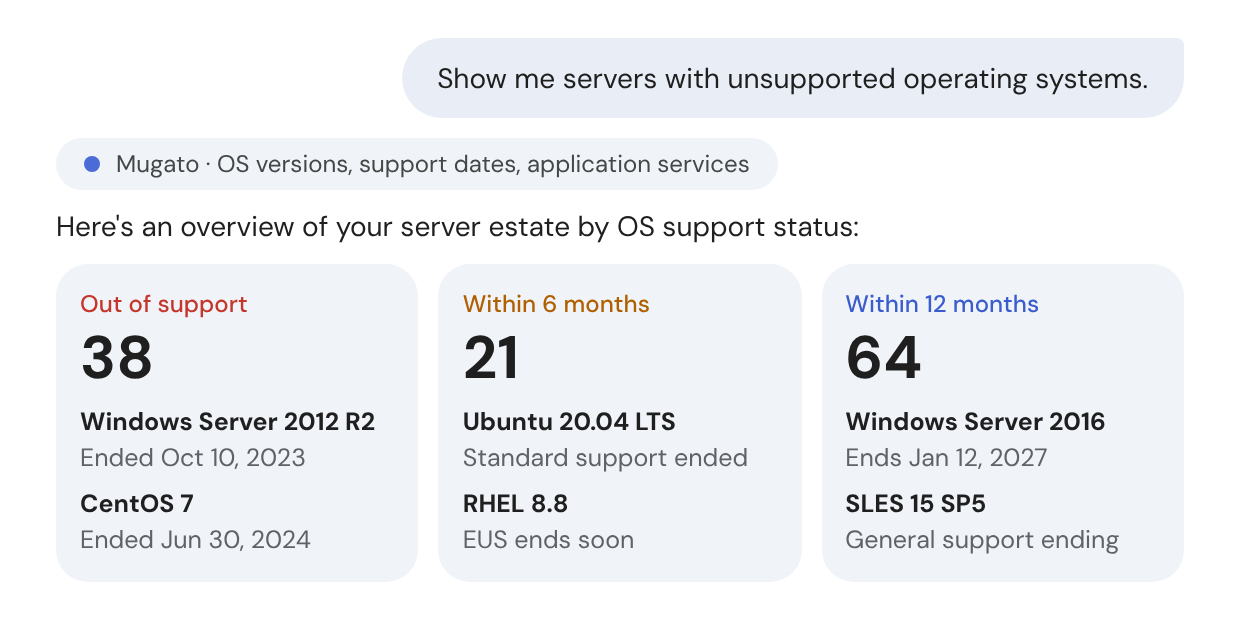
“Show me servers with unsupported operating systems.”
What’s out of support now and what’s approaching, with exact dates.
The view your project actually needs
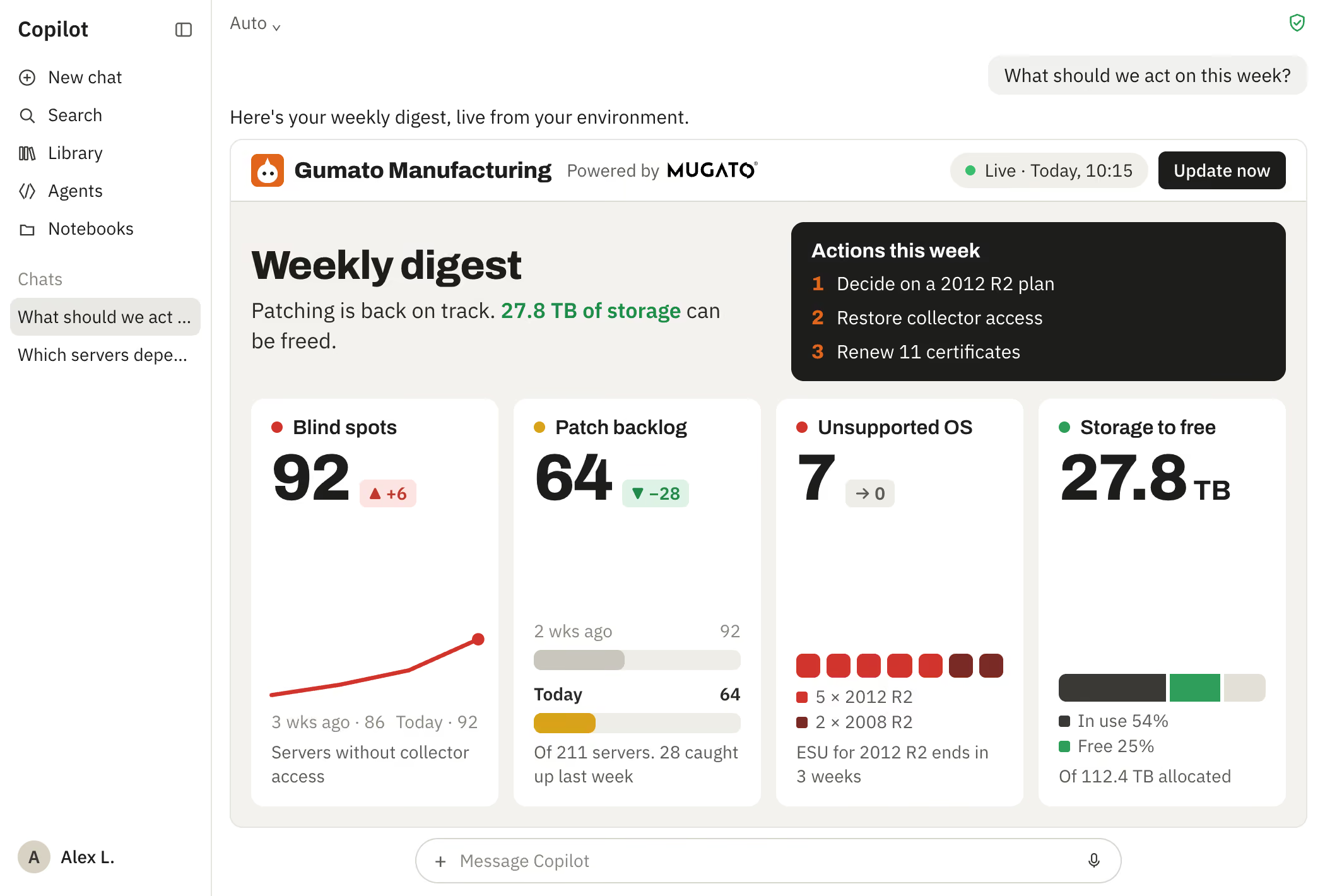
Out-of-the-box dashboards rarely fit the project in front of you, which is how teams end up pasting screenshots into a spreadsheet. Describe the view you want instead and your AI assistant builds it from Mugato’s facts.
Our experts can help you build and refine your personalized dashboards, so you get exactly the information you need from Mugato.
One data center, one program
Wave readiness, blockers and the services still missing an owner, scoped to the estate inside the project and nothing else.
What your week looks like
The handful of numbers a security architect, a migration lead or a service owner checks, in one place, in their own words.
The same view, every morning
Pair it with a schedule and the view refreshes itself, then tells you when something in it changes.
AI is only as good as its context
A person reading a 70% accurate CMDB spots what looks wrong and asks someone. An AI agent doesn’t. It acts on whatever it’s given at machine speed, so every gap becomes a decision made on bad information.
Mugato observes how your IT actually runs, through continuous agentless collection, so your assistants and agents work from measured context.
“By 2028, 99% of I&O-led investment in agentic AI without system data and operating model improvements will fail to achieve sustainable ROI.”
Gartner named Mugato a Sample Vendor for Digital Platform Conductor (DPC) Tools in three 2026 Gartner® Hype Cycle™ reports, covering infrastructure platforms, I&O automation and observability.
Read the announcement →See a NIS2 audit answered in four questions
The evidence NIS2 asks for is already in your environment. Ask your assistant and Mugato supplies it: which services your critical ones depend on, where your traffic goes, which accounts still have reach and which firewall rules still matter. Then it all becomes one personalized dashboard.
Four questions asked in plain language cover risk analysis, supply chain, access control and network security under NIS2. The answers name the eight business-critical services and the 153 they depend on, the 923 servers reaching outside the EU and EEA, accounts with decade-old passwords and 4,810 firewall rule groups unused for a year. A fifth step turns it into one dashboard for management.
Frequently asked questions about the Mugato MCP server
What is the Mugato MCP server?
Do I need the Mugato platform?
Can the MCP server make changes in our infrastructure?
Where does it run, and does it store our meta-information?
Does Mugato use an LLM?
How do we control who can access it?
Do we need a separate security review?
Can we build our own personalized dashboards?
Which AI assistants work with Mugato?
Do I need to write complex prompts?
Will it increase our AI token bill?
Can I get alerts without asking every time?
How do we get started?
Ready to see the
shape of your IT?
Stay ahead with Mugato: get product updates, event invites,
expert insights and more. Or let us show you how Mugato
can map your entire IT landscape without a single agent.
Gartner, Hype Cycle for Infrastructure Platforms, 2026, Dennis Smith, 25 June 2026. Gartner, Hype Cycle for I&O Automation, 2026, Chris Saunderson, 8 July 2026. Gartner, Hype Cycle for Monitoring and Observability, 2026, Pankaj Prasad, Neil Young, 21 July 2026.
Gartner does not endorse any company, vendor, product or service depicted in its publications, and does not advise technology users to select only those vendors with the highest ratings or other designation. Gartner publications consist of the opinions of Gartner’s business and technology insights organization and should not be construed as statements of fact. Gartner disclaims all warranties, expressed or implied, with respect to this publication, including any warranties of merchantability or fitness for a particular purpose.
GARTNER is a registered trademark and service mark and HYPE CYCLE is a registered trademark of Gartner, Inc. and/or its affiliates in the U.S. and internationally and are used herein with permission. All rights reserved.