AI is already changing how infrastructure and operations (I&O) teams work. AI agents are triaging incidents, drafting changes and, in a growing number of teams, carrying them out. We think it's the biggest shift in how I&O runs since the move to cloud.
We see it in our own customer conversations. Most IT teams start by pointing Copilot or Claude at their CMDB and exports. It handles asset lists and properties well, then stops at dependencies, because those were never observed. As AI takes on more operational decisions, what matters most is how good those decisions are.
That comes down to what the AI knows. An agent deciding which server to patch, which workload to move or which alert to ignore is only as good as its picture of the infrastructure underneath: what's running, how it connects and what normally happens. In most enterprises, that picture is still incomplete, out of date or spread across tools that don't agree.
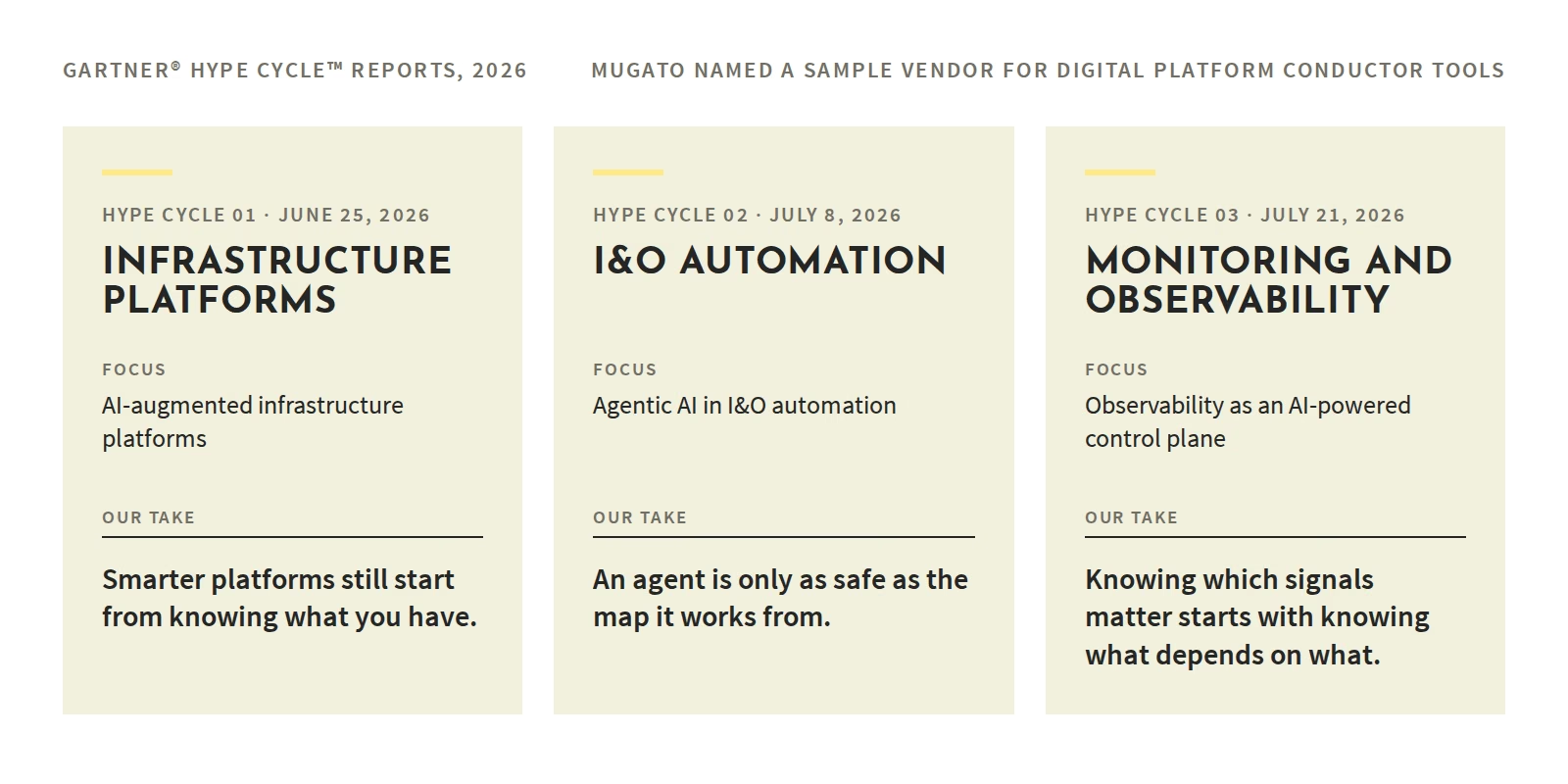
That's the lens we bring to this year's Gartner research. Gartner named Mugato a Sample Vendor for Digital Platform Conductor (DPC) Tools in three 2026 Gartner® Hype Cycle™ reports, covering infrastructure platforms, I&O automation and observability. Our view is that the next era of I&O belongs to teams that can see the whole film of how their IT runs: every observation kept over time, so people and agents can tell what's normal, what's rare and what stopped. That's why this recognition matters to us.
Mugato is a Sample Vendor for Digital Platform Conductor Tools in three 2026 Gartner Hype Cycle reports:
- Hype Cycle for Infrastructure Platforms, 2026, June 25, 2026
- Hype Cycle for I&O Automation, 2026, July 8, 2026
- Hype Cycle for Monitoring and Observability, 2026, July 21, 2026
Each link opens the report on gartner.com, where a Gartner client login is required.
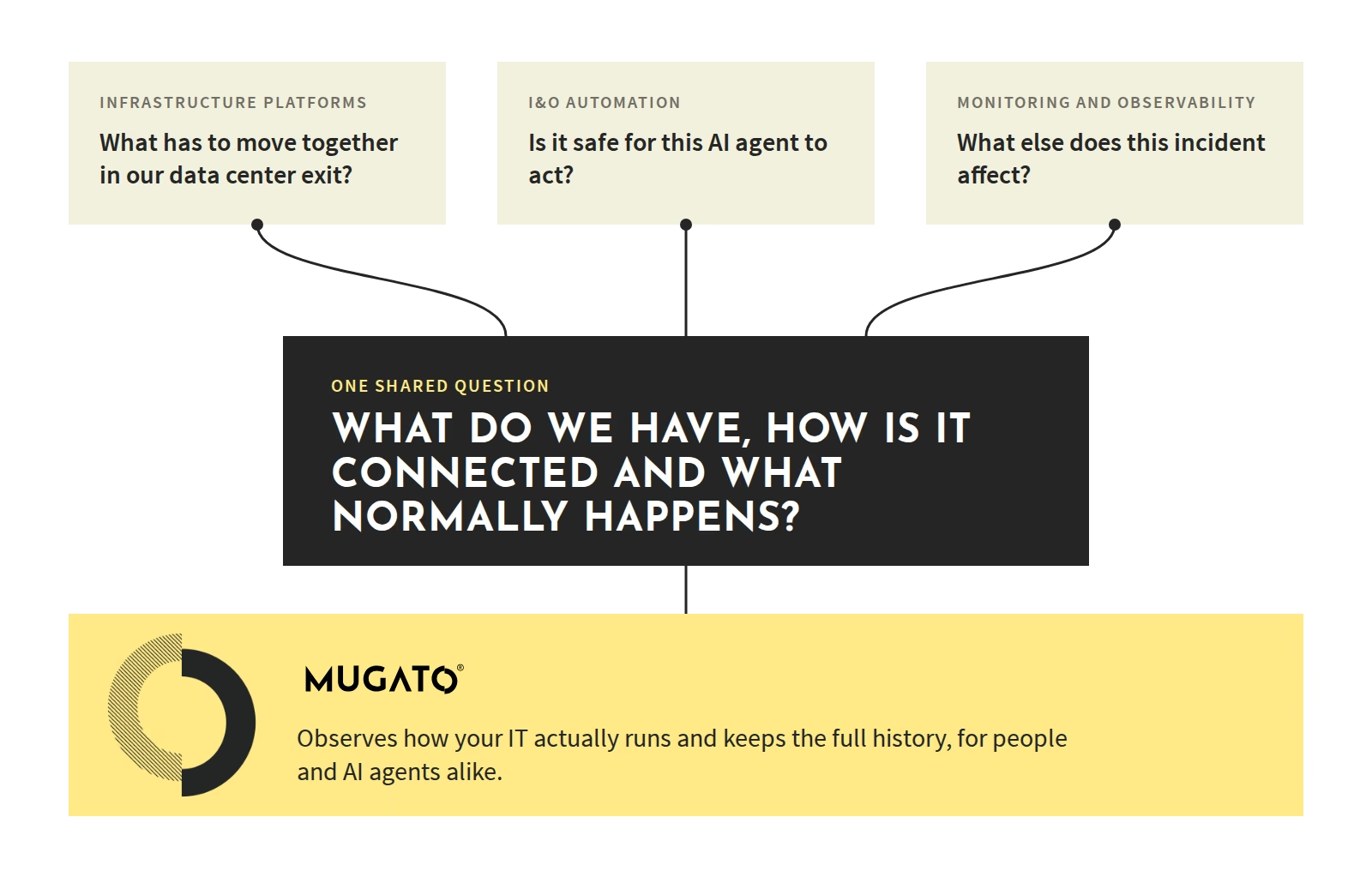
Getting that picture right is what Mugato is built for. Mugato observes how your IT actually runs and keeps the full history, so you can see what a change will touch before you make it. Ask it in plain language, or connect your AI agents to the same facts.
Below, we walk through each report, what we think it signals and why it matters if you're responsible for any part of your IT.
What a Hype Cycle is and what a Sample Vendor mention means
A Gartner Hype Cycle shows how a set of innovations matures over time. Innovations move through five phases: Innovation Trigger, Peak of Inflated Expectations, Trough of Disillusionment, Slope of Enlightenment and Plateau of Productivity. Each Hype Cycle focuses on one domain.
Inside every Hype Cycle, each innovation gets its own profile, and Gartner names a handful of Sample Vendors to illustrate who is working in that space. It isn't a ranking, and it isn't an endorsement. It means Mugato is listed as an example of a vendor working on that innovation.
What digital platform conductor tools are and where Mugato fits
Gartner defines the category this way:
“Digital platform conductor (DPC) tools optimize the management of IT infrastructure costs, operations and life cycles by aggregating disparate data and supporting federated management across all environments and locations.”
Mugato provides the facts that kind of management depends on:
- The whole picture, not one frame. Every connection, process and utilization reading is kept at minute granularity, so you can see what's normal, what's rare and what stopped, and compare any two points in time.
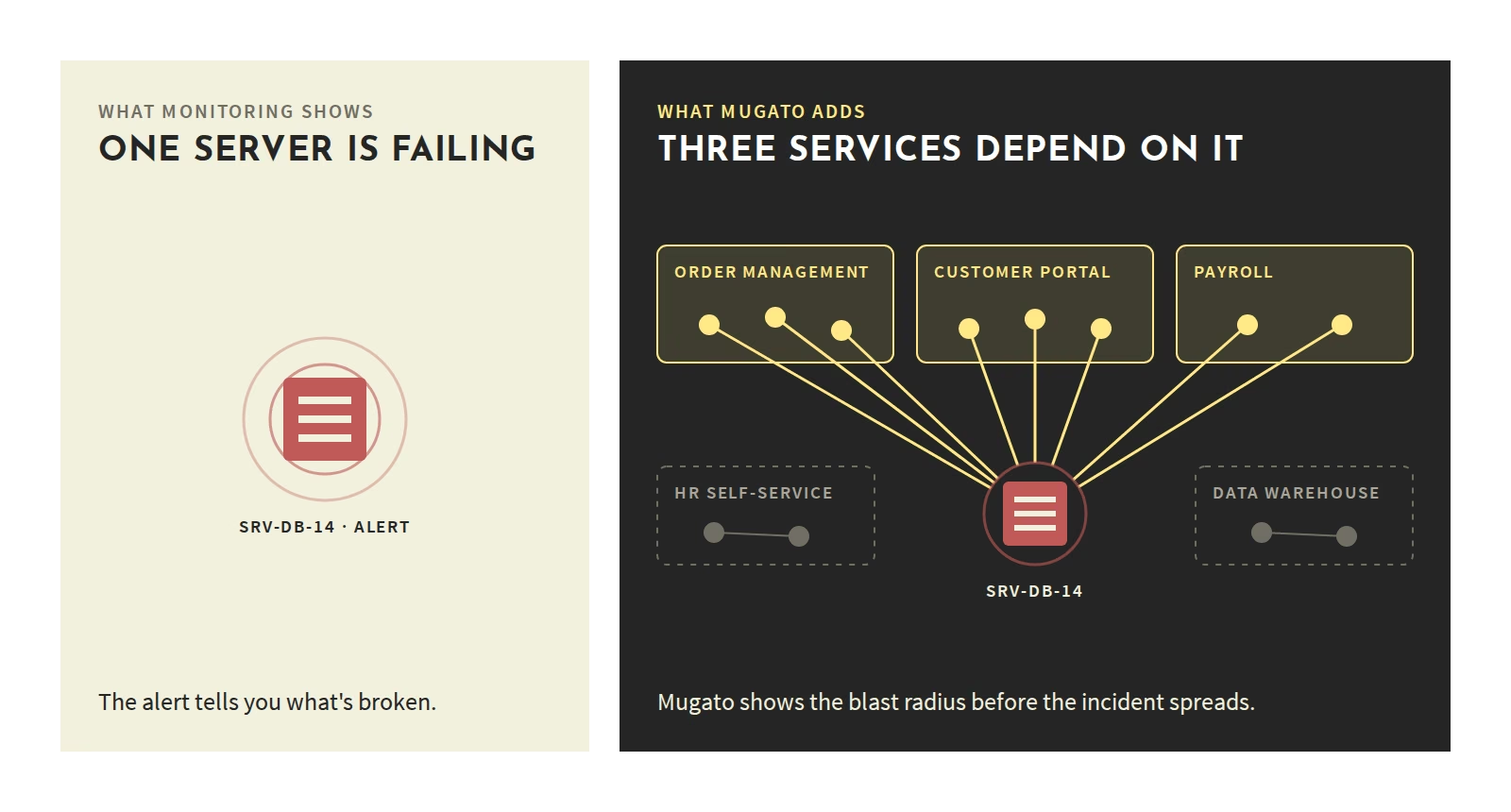
- See what a change will touch. Mugato groups servers into application services automatically and keeps them current, so the blast radius of any change is visible before you act.
- Facts your agents can act on. Mugato reads the facts directly from your IT, with no LLM inside the platform. Your AI agents get answers grounded in what's actually running, and the same question always gets the same answer.
- Your view, not a vendor's dashboard. Ask in plain language and get the view your job needs, for today or any day in the past. Your AI agents query the same facts.
- Nothing to install. Collection is agentless and read-only, through the interfaces administrators already use.
Many tools in this space bring together data from the systems you already have. Mugato observes your IT directly, so its facts don't depend on how complete or current those systems are.
Three reports covering three aspects of IT
Hype Cycle for Infrastructure Platforms, 2026
What it covers. How infrastructure platforms are using AI to become more efficient and automated, and how heads of I&O should prepare to deliver AI-augmented platform capabilities.
“The need to maintain a coherent view of all hybrid infrastructure resources and their dependencies that are aligned with changes to services, applications and components, and the configuration of their promised performance levels.”
What we think it means. Platforms are getting smarter, but every AI-augmented capability still starts from an accurate picture of what's running and how it connects. In most enterprises, that picture is split across an outdated CMDB, spreadsheets and the memory of a few senior engineers. That's the gap we work on: one current picture of what runs where, across on-premises and cloud.
Why it matters to you. If you're planning a data center exit, a cloud move or an M&A integration, the first question is always what you have, how it's connected and what normally happens. Mugato answers that from how your IT actually runs. It groups servers into application services automatically, so you can see what has to move together and what a change will touch before the change window.
Hype Cycle for I&O Automation, 2026
What it covers. How agentic AI is transforming I&O automation, and how leaders can implement automation, build team capability with AI and balance cost optimization with value creation.
“By 2028, 99% of I&O-led investment in agentic AI without system data and operating model improvements will fail to achieve sustainable ROI.”
What we think it means. Agentic AI takes action on its own. An agent that decommissions a server it believes is unused, or reroutes traffic around a service it can't see, can do damage faster than any person could. Our view: an agent is only as safe as the map it works from.
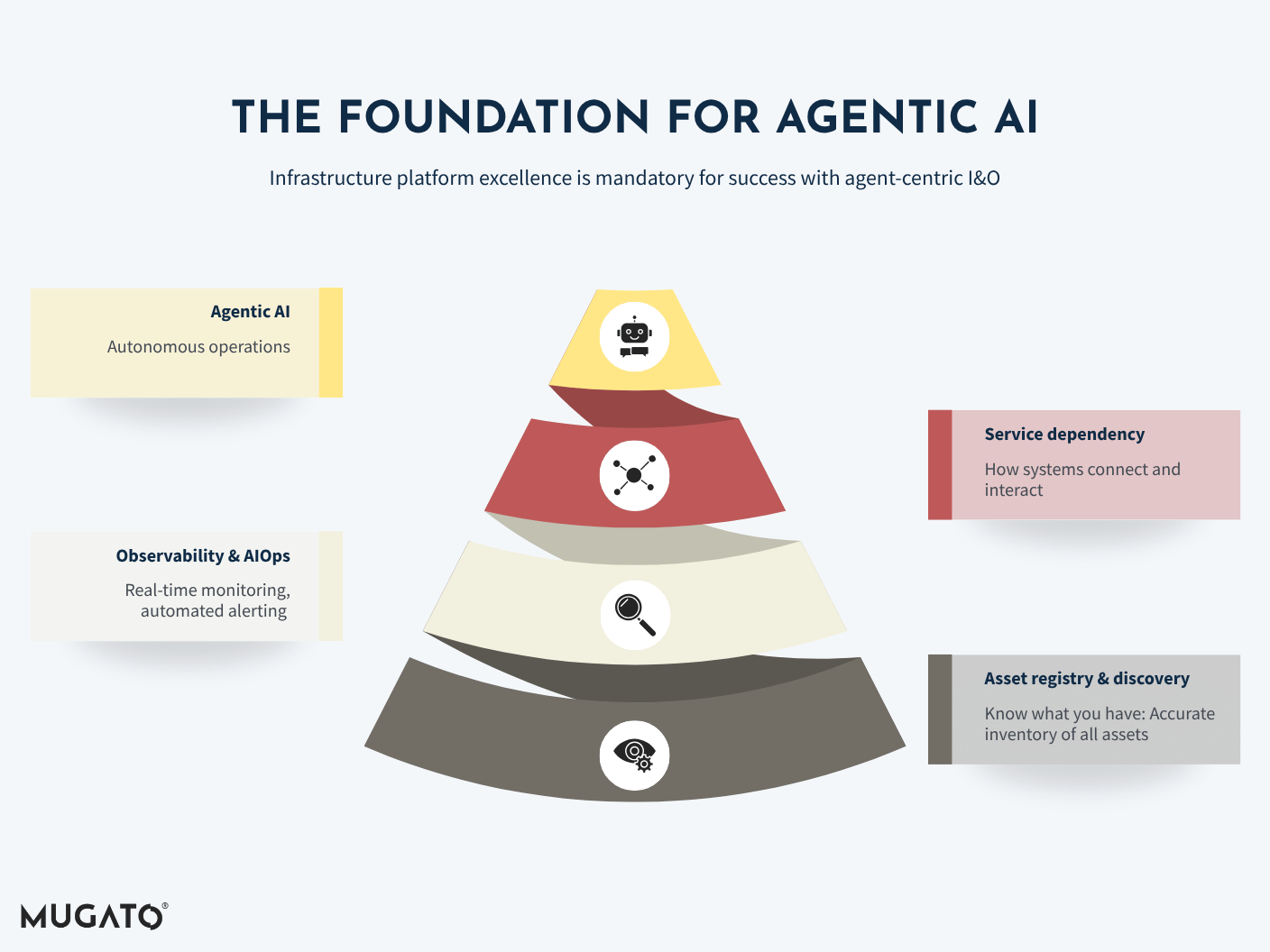
Why it matters to you. If you're building an AI roadmap for operations, start with the facts your agents will act on. Ask your AI assistant for a prioritized migration plan for the application services in one data center, and you get a sequenced wave plan built from observed behavior, with risk flags included. Your assistant handles the language and Mugato supplies the facts, so the same question asked two ways gets the same answer.
There's no LLM inside Mugato, and access is read-only. Answers draw on everything Mugato has observed since it was deployed, so the sooner you start, the more your AI can tell you. For more, read The foundation for agentic AI.
Hype Cycle for Monitoring and Observability, 2026
What it covers. How observability is becoming an AI-powered control plane for operations, and how heads of I&O can prioritize investments, optimize costs and build autonomous, resilient systems.
“The earlier challenge, where up to 84% of users struggled with the cost and complexity of their observability responsibilities, has intensified with AI workloads and telemetry explosion. Organizations are moving from ‘collect everything’ to ‘collect what matters for decisions.’”
What we think it means. This one stands out to us because observability is where most enterprises have already invested heavily. Yet the hardest questions in an incident or a change are about structure: what a service consists of, what it relies on and what breaks next. Knowing your service dependencies tells you which signals matter for which service.
Why it matters to you. If you already run mature observability, keep it. Mugato keeps the history your monitoring lacks: what normal looks like and what depends on what. You see the blast radius of an incident or a change before it spreads, and findings flow to the ITSM and SIEM tools that already alert your team. Read more in Beyond root cause: why affected cause analysis matters.
What this means for you
Recognition doesn't replace proof. Before you look at any tool, it's worth asking your own team three questions:
- If you had to switch off a server tomorrow, how long would it take to find every service that depends on it?
- Does your automation or AI roadmap assume your CMDB is current? Is it?
- When an incident hits, can you see what else it affects, or only what's broken?
Today, most teams answer with a CMDB export, a long meeting or an expensive consultant. By the time the answer arrives, it's already stale. Mugato lets you ask your IT itself, for today or any day in the past.
Three reports, three aspects of IT, one question. We think the organizations that can answer it will get far more from their platforms, their automation and their observability. Know your IT before you change it.
Most of our customers start with one use case, see the results on their own estate and expand from there. Want to see how quickly your own estate can answer those three questions? Book a demo and we'll show you.
The perspective in this article is Mugato's own, formed through conversations with customers and industry analysts and our experience mapping complex infrastructure estates.
Gartner, Hype Cycle for Infrastructure Platforms, 2026, Dennis Smith, 25 June 2026. Gartner, Hype Cycle for I&O Automation, 2026, Chris Saunderson, 8 July 2026. Gartner, Hype Cycle for Monitoring and Observability, 2026, Pankaj Prasad, Neil Young, 21 July 2026.
Gartner does not endorse any company, vendor, product or service depicted in its publications, and does not advise technology users to select only those vendors with the highest ratings or other designation. Gartner publications consist of the opinions of Gartner's business and technology insights organization and should not be construed as statements of fact. Gartner disclaims all warranties, expressed or implied, with respect to this publication, including any warranties of merchantability or fitness for a particular purpose.
GARTNER is a registered trademark and service mark and HYPE CYCLE is a registered trademark of Gartner, Inc. and/or its affiliates in the U.S. and internationally and are used herein with permission. All rights reserved.