

At Gartner's recent IT Infrastructure, Operations & Cloud Strategies Conference, analysts made a bold prediction: AI agents are poised to be the biggest disruptor of enterprise infrastructure operations since the introduction of the cloud. According to Gartner research, by 2028, at least 15% of day-to-day work decisions will be made autonomously through agentic AI, up from virtually 0% in 2024.
That's a remarkable shift. But none of this is possible without a reliable foundation of accurate, always-updated infrastructure data. Without knowing exactly what you have, how it's connected, and what depends on what, AI agents are flying blind. The consequences of autonomous decisions based on wrong data can cascade through your entire organization.
The data quality crisis holding back digital transformation
The Configuration Management Database (CMDB) is, for many organizations, the backbone of IT visibility. The CMDB is the place where teams should be able to find a complete, accurate picture of their infrastructure. But for most organizations, that promise has never fully materialized.
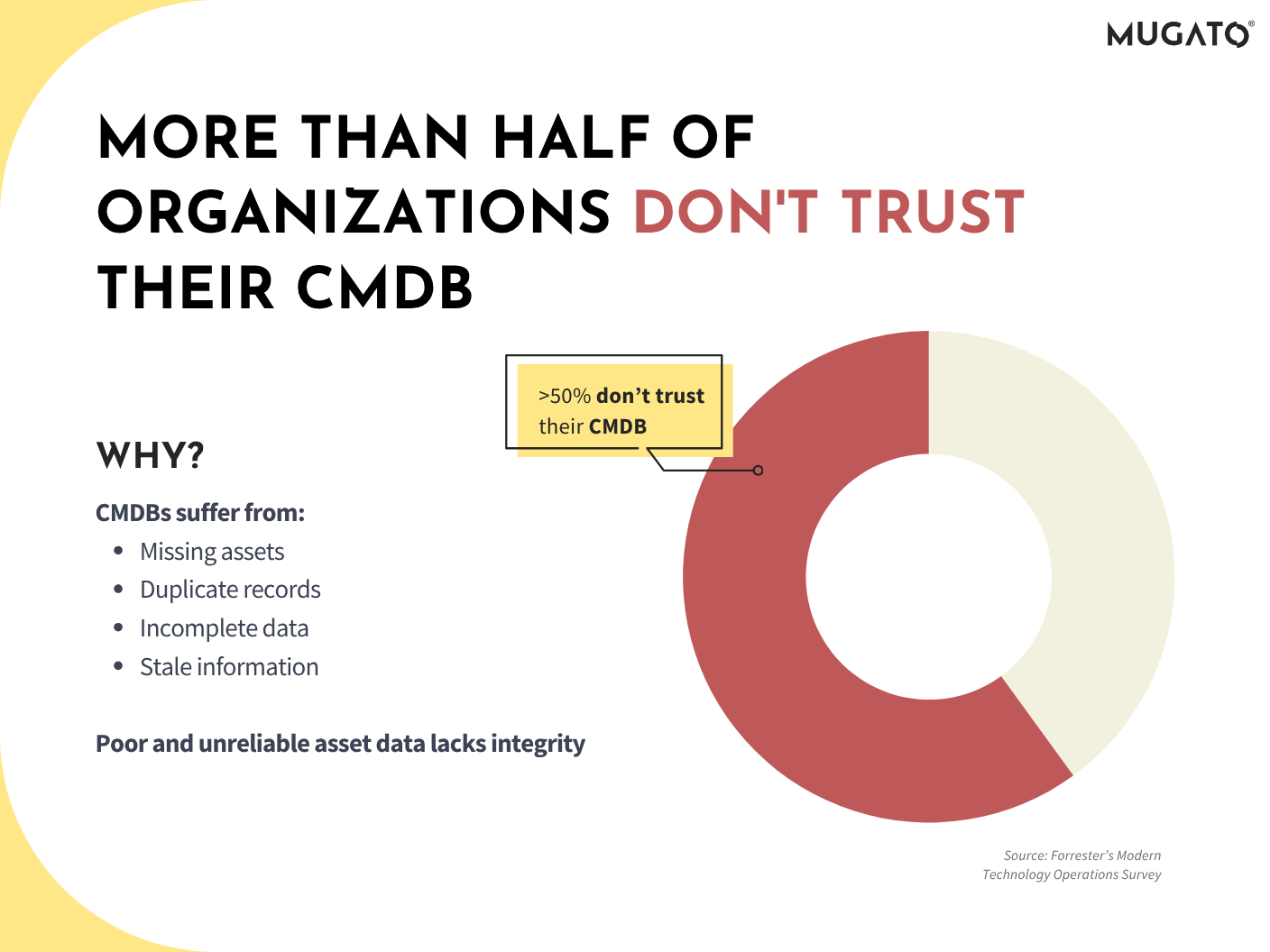
According to Forrester research, over half of those surveyed do not trust their CMDB. This undermines everything from incident response to change management to compliance reporting.
The reasons are familiar to anyone who's worked in enterprise IT. CMDBs suffer from:
- Missing assets: single discovery tools can't catch everything
- Duplicate records: different identifiers creating phantom configuration items
- Incomplete data: manual entry leaves gaps
- Stale information: infrastructure changes faster than records can keep up
Inaccurate configuration item data delays incident resolution and degrades change quality across the board. In a recent example with one of our customers, the team discovered their ServiceNow CMDB showed a SQL Server running Windows Server 2012 when the actual system had been upgraded to 2019. Worse, they found the same server listed twice with different configurations, both tied to the same business application. When they tried to map application dependencies, they referenced servers that no longer existed under those names. You can find examples like these in pretty much every large enterprise.
And the problem is getting worse. Shadow IT accounts for 30-40% of IT spending in large enterprises, with some estimates above 50%. When 65% of SaaS applications are unsanctioned, the gap between what you think you have and what's actually there becomes a chasm.
The impact extends well beyond IT. Poor data quality decreases overall productivity and nearly 1 in 2 cyberattacks now stem from shadow IT vulnerabilities. The cost of a data breach averages $4.88 million, and over one-third of breaches involve shadow data stored in unmanaged data sources, putting additional weight on organizations to get their data under control.
Why "source of truth" matters
The phrase "single source of truth" gets thrown around a lot in enterprise IT. But what does it actually mean?
A true source of truth is an authoritative, always-current foundation that other systems and teams can rely on without question. When you have one, you eliminate the scenario every IT professional knows too well:
Here's the source of truth test: if you turned off a data source tomorrow, what would happen? If teams need to hire staff to manually recreate what the system does automatically, such as tracking assets, maintaining toxic lists and mapping dependencies, that's a genuine source of truth. If not, it's just another data silo competing for attention.
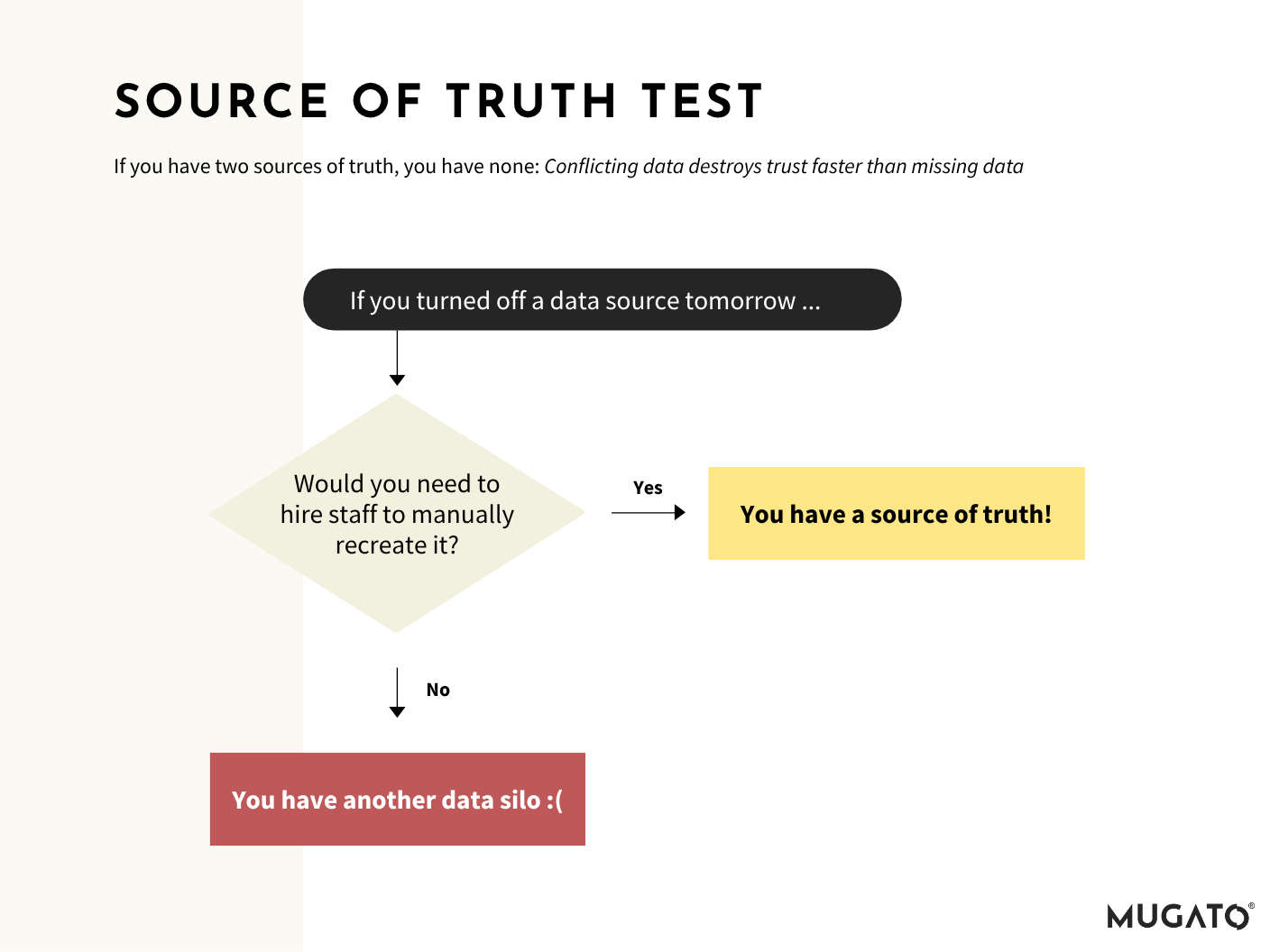
Consider the toxic list use case: tracking software that shouldn't be installed across your environment. In large enterprises, entire teams, sometimes two to five people per region, per country, spend their days manually identifying and reporting prohibited applications. With a reliable data foundation, this becomes automated, real-time and impossible to miss. Turn off that data source, and you're back to hiring headcount.
And once trust is lost, teams start keeping their own data sets, creating the data silos that the CMDB was supposed to eliminate.
The bridge between observability and enterprise architects
There's a structural gap in how businesses approach infrastructure visibility. Walk into one conference room and you'll find the observability team focused on real-time monitoring, alerts, and incident response. Walk into another and you'll find enterprise architects mapping business capabilities to technology components and planning long-term transformations.
These are often literally different conferences (including Gartner), different teams, different budgets. Yet they need the same underlying truth: what infrastructure exists, how it's connected and what business services depend on it.
Service dependency mapping sits at this intersection. Knowing that Server A exists is only the beginning. You need to understand that Server A hosts Application B, which depends on Database C, which supports Application Service D. When something breaks at any point in that chain, you need to know the blast radius instantly. When you're planning a migration, you need to know exactly what will be affected.
Organizations with complete visibility into their IT dependencies are better positioned to prevent cascading failures because they understand how one issue (like an SSL library vulnerability) could ripple across an entire network. Dependency intelligence transforms change management from educated guessing into precise impact analysis.
How to build a reliable data foundation
The problem is clear: CMDBs filled with stale, incomplete and conflicting data. The solution lies in rethinking how infrastructure data is collected, analyzed and maintained.
Discover everything with agentless technology
Traditional observability tools require agents installed on every device or credentials configured for every system. Agent-based discovery creates gaps: devices without agents go undetected (hello, shadow IT) and credential management becomes a burden. Agentless network analysis solves this by identifying everything with an IP address: IT, IoT, OT, and cloud assets, without touching the devices themselves. If it communicates on your network, it gets discovered. No agents to deploy, no credentials to manage, no devices left in the dark.
Collect data continuously
Most observability tools run periodically: daily, weekly or even less frequently. Between scans, data decays. Continuous collection with real-time updates solves this. When infrastructure changes, your data changes with it. Minute-level granularity means you always know the current state, not what existed when the last scan completed.
Map dependencies automatically using behavioral analysis
Traditional dependency mapping requires manual tagging, predefined application libraries and constant maintenance. Static maps decay the moment something changes. Behavioral analysis takes a fundamentally different approach: instead of relying on what you tell the system about your applications, it observes actual communication patterns to understand how systems interact. By analyzing traffic frequency, volume and protocols, it distinguishes mission-critical continuous connections from occasional batch jobs and automatically clusters related components into application services without manual configuration.
Use AI to define service boundaries without manual effort
The hardest part of service dependency mapping has always been defining where one service ends and another begins. Manual approaches require teams to tag every component, maintain application dictionaries, and constantly update definitions as software changes. AI-driven process mining eliminates this burden by analyzing communication patterns to automatically identify service boundaries. Whether your applications are off-the-shelf, custom-built, or third-party, behavioral intelligence recognizes them by how they behave, not by matching signatures in a library.
Feed your CMDB automatically
Data that lives in a standalone system provides limited value. The ideal situation is when accurate, continuously updated infrastructure data flows directly into your CMDB, enriching ServiceNow or other ITSM tools with intelligence they can't generate on their own. Automated integration means your existing workflows keep running, just with smarter data. No manual imports, no duplicate records, no synchronization headaches.
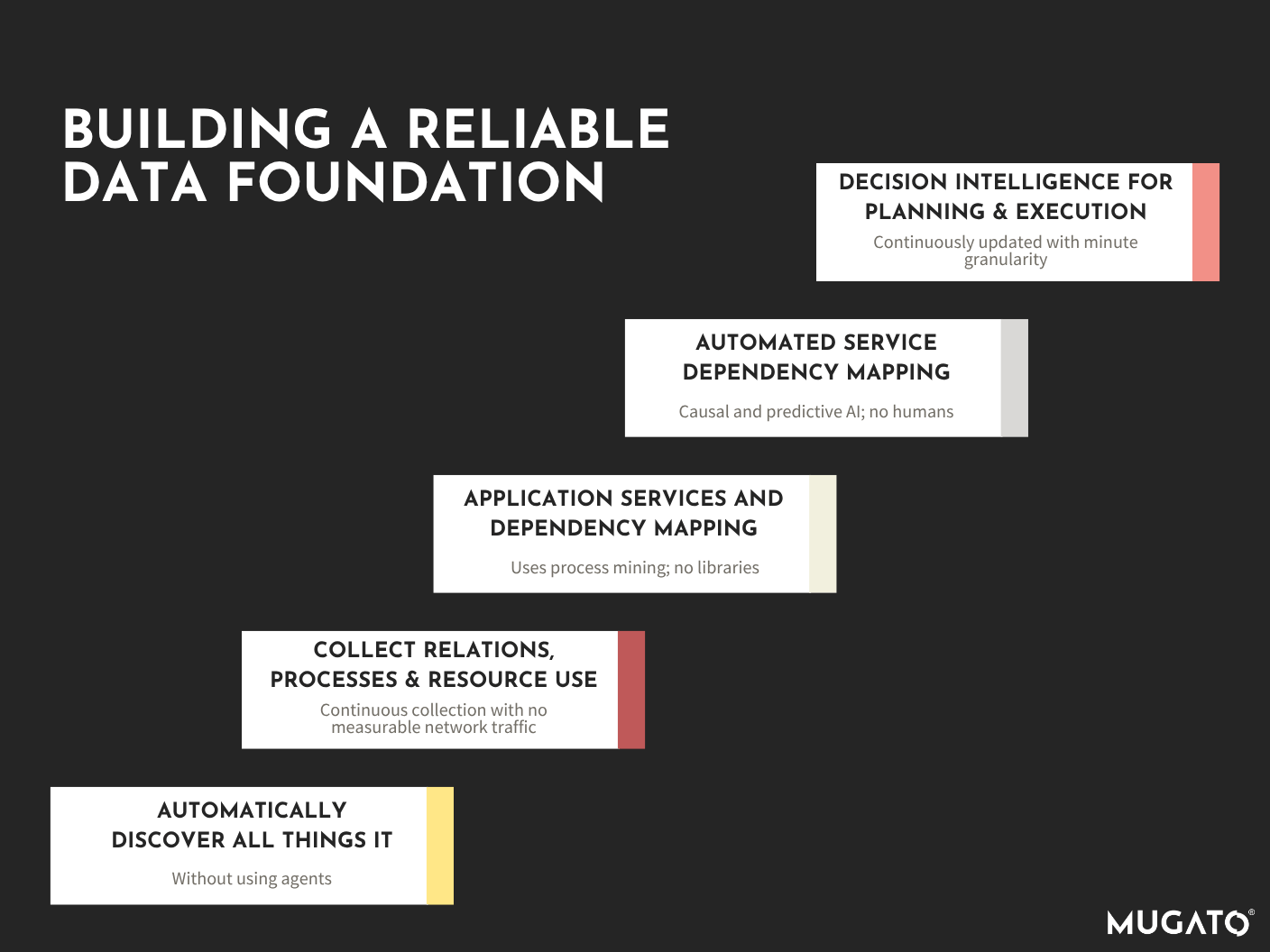
Organizations that use an agentless infrastructure intelligence platform, like Mugato, get data teams actually use because it's accurate, current and already embedded in the tools teams rely on every day.
The agentic AI prerequisite
To take advantage of the agentic AI transformation in ITOps, you need foundational technologies in place first. The path to agentic AI runs through platform excellence in asset registries, service dependencies and observability.
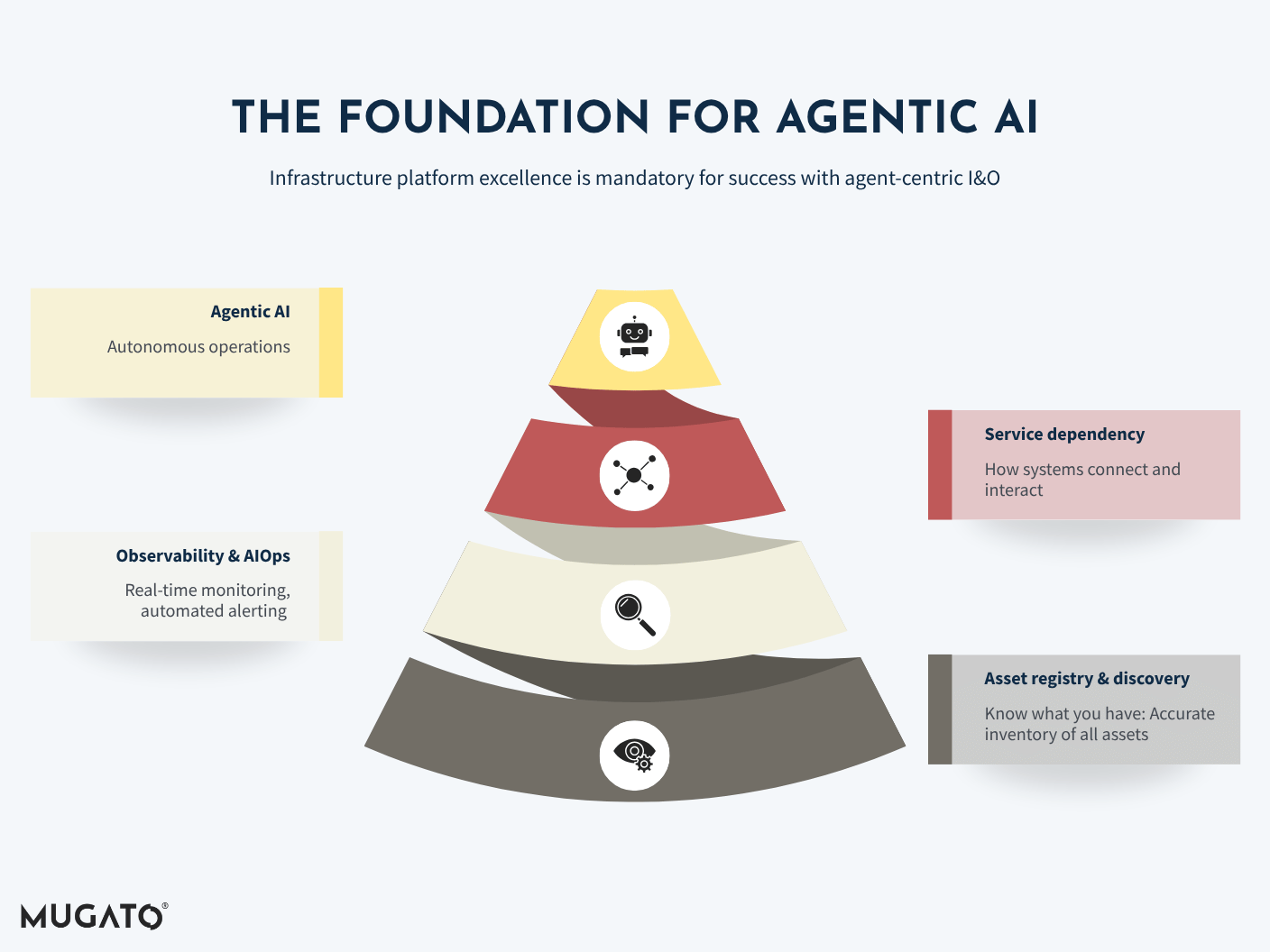
The consequences of deploying AI agents on top of wrong, missing or outdated data are catastrophic.
Consider what happens when an AI agent is authorized to automatically deploy infrastructure, manage capacity or respond to incidents. If the underlying data says a server doesn't exist when it does, or shows a dependency that was removed months ago, the agent will make confident, autonomous decisions based on fiction. At scale, these errors compound.
Gartner predicts that over 40% of agentic AI projects will be canceled by the end of 2027 due to escalating costs, unclear business value, or inadequate risk controls. The organizations that succeed will invest in data quality before deploying autonomous systems.
Building for the AI-enabled future
The promise of agentic AI is real. Autonomous systems that can manage infrastructure, respond to incidents, and optimize operations without constant human intervention will fundamentally change what IT teams spend their time on.
In addition to accurate infrastructure data, organizations need to embed data in their daily operations, feeding the ITSM tools teams already rely on and creating value that's immediately visible. When data becomes indispensable and turning it off would mean hiring entire teams to recreate its function, you've built the source of truth.
The future depends on the data foundation AI models rely on:
- Asset registries that are complete
- Service dependencies that are current
- Observability data that reflects production reality
For IT leaders, the priority is clear: invest in the infrastructure data that makes AI actually work.